|
Freshwater MusselsFreshwater mussels are an important part of our ecosystem. They tell us a lot about the condition of rivers and lakes without even having to do tests.
Virginia Tech researchers seek new ways to help endangered mussel species. Ohio, Alabama, Virginia and 10 other states drained by the Ohio river system were involved in this study of North American mussels.
These creatures play an extraordinary roll in nation's environment and economy. These folks are concerned about saving America's freshwater pearly mussel.
Submerged in clear and clean waters of rivers and lakes and ponds and streams around the world is a little known but incredibly diverse group of animals known as freshwater mussels. They are mollusks, shellfish similar to their cousins, the saltwater oysters and clams. These simple creatures exist of a soft body within two hard shells. Their body has gills for breathing, digestive tract for eating and a large muscular foot to help it move. Mussels extract minerals and turns them into shell material, adding one layer at time, called nacre.
They are a major food source for herons, raccoons, and muskrats.
Specialists use size, shape, color and markings to identify species.
Each individual species has a Latin name and most have colorful common name too, such as Pistol Grip, Purple Pimple Back and Pocket Book.
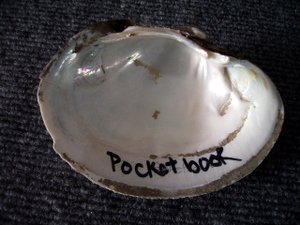 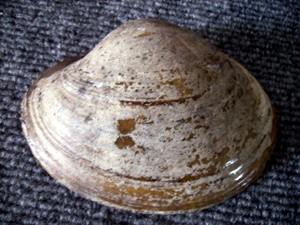 Pocketbook Freshwater Mussel Ohio State professor, David Stansbery, is curator of one of largest collection of freshwater mussels in world with close to two million specimens.
For naming mussels he picks a characteristic of shell to help amateur identify them. There are plenty of species to name more than 1,000 world wide. Nearly a third are found in North America and half of those in the Ohio and Tennessee Rivers and tributaries.
Adult mussels lead a passive life on bottom of lake or stream moving only a few hundred yards in a life time of 60 years. They are transported to other areas by way they're reproduced. Female freshwater mussels release mature lavae glochidia, which drift in currents until, if not eaten, attach to a fish's gills and fins. Often a specific type of mussel needs a specific type of fish, such as a blue gill or bass. To atttact a host fish a female mussel sometimes uses a lure by flapping part of her body, for example, to look like potential food. It is an ingenious way to give the glochidia the chance to hitch a free ride. Often they are transported hundreds or thousands of miles to a different habitat. With this expanded range, they have a better chance of survival.
Glochidia die without a host fish. So if host fish are driven out by pollution or other problems, the mussels that need that fish will die off. The glochidia attach to a fish for 1-4 weeks, maturing as tiny specks feeding on the fish's blood. Dozens can attach without killing it. That is how a species spreads. Host fish provides massive transit for future generations. After the free ride, still tiny, individuals drop off and bottom dwelling begins.
Enjoy recipes for freshwater mussels and learn about pearl clamming in North America. Watch videos of pearl harvesting, see photos of mussel shells, read how these creature form a bond between my childhood and adulthood home, and learn what valuable articles were made from freshwater mussels years ago.
|