Palawan Princess - 5 Pound Pearl - Up for Auction
by Bonham's Auction House
(Los Angeles, California)


Palawan Princess at Bonham's Auction
Rare and Immense Natural Non-Nacreous Pearl—“The Palawan Princess”
Bonhams Natural History Auction
Sunday, 1PM, December 6, 2009 in Los Angeles
Tridacna gigas
Saltwaters near The Philippines
Possibly the second largest pearl ever discovered and documented, surpassed only by the renowned 14 pound (approx 31,893.5 carats) “Pearl of Allah” (so-called because it resembled the turbaned head of Allah), the present pearl is the product of the giant clam shell Tridacna gigas found off the coastal waters of the Philippines.
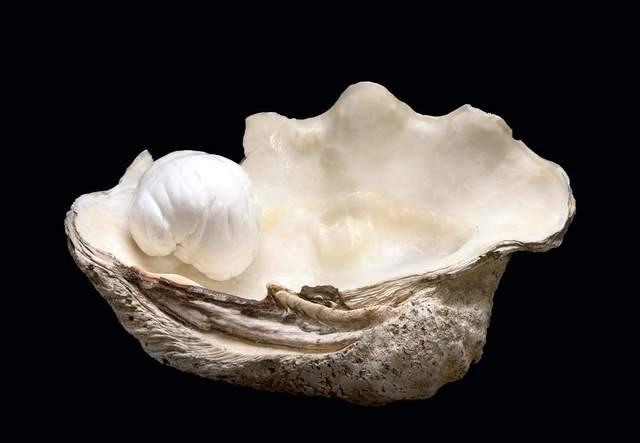
Palawan Princess
Almost any shelled mollusk can, by natural processes, produce some kind of “pearl” when an irritating microscopic object becomes trapped within the mollusk’s mantle folds and the conditions are correct. Interestingly, not all “pearls” are made of nacre, that combination of aragonite (calcium carbonate and conchiolin that is secreted from a mollusk and layered together to form what gemologists call a “nacreous” pearl. Some marine animals—namely snails and clams—produce gorgeous gems made up of non-nacreous calcium carbonate. Calcite, rather than aragonite is the primary material here and they are, thus, technically classified as calcareous concretions. The pearl which is not “mother-of-pearl” might best be qualified “porcellaneous.” It indeed possess a brilliant luster like porcelain, a hard resistant appearance, and occurs in a variety of colors according to the species producing it. The Tridacna gigas was first described by Lamarck in 1758,
The present example is an incredible, five-pound pearl—measuring six inches in diameter and bearing an uncanny resemblance to a human brain. According to the gemologists who examined it and provided a certificate of authenticity:
“This is an once-in-a-lifetime look at one of nature’s most unique treasures,” said Mitch Jacubovic, director of EGL USA. “A pearl this size is not only one of the largest ones we’ve ever seen, it is among the largest pearls ever seen anywhere.” David Bidwell, a senior appraiser with Universal Gemological Services, called it “clearly one of the most valuable pearls of its kind in the world today.”
Weighing an impressive 5 pounds (approximately 11, 339 carats)
Estimate $300,000-400,000
Accompanied by a EGL USA gem lab report stating “natural non-nacreous pearl from the species Tridacna gigas.”
Accompanied by half the original giant clamshell showing the point of attachment where the pearl formed.
Inquiries:
Claudia Florian G.J.G.
claudia(DOT)florian(AT)Bonhams(DOT)com
Tom Lindgren
tom(DOT)lindgren(AT)Bonhams(DOT)com
1-323-436-5437
Comments for Palawan Princess - 5 Pound Pearl - Up for Auction
|
||
|
||
|
||
|
||
|
||
|
||
|
||
|
Click here to add your own comments Join in and write your own page! It's easy to do. How? Simply click here to return to Pearl News. |