|
Working of the Pearl Mantle
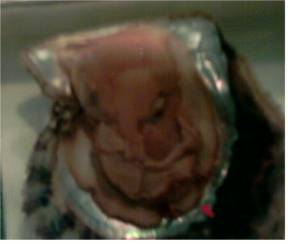
The pearl mantle is shown in this photo of a preserved akoya oyster at the Mikimoto Pearl Island Museum by a red arrow in the lower right hand corner pointing to the pearl mantle tissue, which circles the outer edge of the oyster.
This description below in quotes of the working of the mantle tissue in an oyster comes from the Mikimoto Pearl Island Museum in Toba, Japan.
"Just inside the two halves of the oyster shell lives a membrane called the mantle. This mantle surrounds the inner organs and filters the flow of water and nutrients.
This process capitalizes on the nacre secreting function of the mantle cells." This pearl mantle strip is carefully sliced away from an oyster and cut into tiny "pieces." These pieces are then inserted in another oyster along with a shell bead. The mantle tissue "piece" forms a pearl sac around the shell bead and layer after layer of pearl nacre is then secreted to the shell bead, making a pearl. The thicker this outer pearl nacre is, the better the pearl. If the layer is thin, it can crack and peel over time, leaving you with a worthless pearl or piece of jewelry. For freshwater pearls, usually just a "piece" of pearl mantle tissue from a freshwater mussel is inserted into a live mussel, without the shell bead. Several "pieces" can be inserted into freshwater mussels, each secreting nacre to form a pearl, making freshwater pearls entirely pearl nacre without a shell bead for a nucleus. Some of these grow into the shell itself, forming blister pearls. Because more pearls can grow inside of freshwater mussels, the price is lower than sea pearls. At times, when a foreign object enters a freshwater mussel or seawater oyster, the object catches on the mantle tissue, which is along the outer rim of the bivalve, tearing a part of the mantle tissue off and carrying the mantle tissue with it into the inner most part of the mussel or oyster. It's this tissue that forms a pearl around the foreign object, solving the mystery of the pearl. |